
We stepped out the front door of our residence into the brisk morning air just after breakfast, our hands full with shovels, bags, and boots. We were in a bit of hurry — the minga began at 9am and we still had a ways to travel. It took me a second to realize that we also didn’t quite have a way to get to the minga either. Our community currently only has one car and, at that moment, it was carrying another part of our community down the other side of the mountain to a community about two hours away. That left us to find our way down the valley to the minga in to Guangoliquin. Sometimes I wonder why God allowed me to hike the PCT during this specific time in my life, in between graduating college and this year of mission. Although I’m sure the answer will continue to become clearer as time goes on, sometimes I get a glimpse of the reason — for example, when we walked up to a camión passing by the Church to ask for a ride. Hitchhiking is not a common passtime in neither Ohio nor Alabama, however it’s an essentially part of life as a thru-hiker and, as I’m learning, in the mountains of Ecuador. We loaded our showels into the back of the camión and climbed into the front. There was just enough space on the passenger side bench for Germán and I to squeeze in next to each other. If anyone else had joined us for the ride, they would have had to ride in the back with the showels. Luckily, we were sent two by two, spiritually following the example of the first disciples. Pratically, my Spanish was not quite good enough to make the journey alone, not to mention the fact that I hadn’t the slightest clue where we were going.
The journey down the valley was slow and bumpy as we crawled along the dirt road. We needed to descend about 600 meters, or roughly 2,000 feet, from Simiatug to reach the community, which was still nestled at a respectable 8,800 feet above sea level. Along the way, we made gentle conversation with the driver, who was from a different community further down the valley. Germán introduced me as an ingeniero, which I quickly corrected to matemático. There was a big difference between the theorical mathematics that I had studied in college and the work of an engineer in this country. These were expectations that I needed to manage, especially because I still wasn’t quite sure exactly what we would be doing at the minga — it had probably been explained to me, but I must have lost it in translation. We chatted about our home towns, comparing Germán’s village in the next province to the north to my experience in the United States. Our driver was from one of the only communities in the parish that Germán hadn’t visited during his two years of mission in the area. He simply hadn’t had a reason to travel down there yet, he told me. It took me entirely too long to figure out that Germán is the parish secretary in Simiatug. He began the job after spending a year abroad on mission in Mexico, similar to what I’m doing this year in Ecuador. My arms hugged my mission bag tightly under my poncho, containing ~ theorically ~ everything that I would need for our time at the community. It was a collection of supplies that I was continually refining. Today, it contained a liter of water, sunscreen, hand sanatizer, a couple squares of toilet paper (just in case), a few snacks, an extra jacket, a little bit of money, and a book of songs in both Kichwa and Spanish. Our conversation lapsed briefly into silence, giving me time to enjoy the incredible scenery of the Andean valley around us. It was my first time descending down this road. It seemed like there was always a new path to take, a new direction to explore. Along the way, we picked up someone else walking with a shovel along the road. I breathed a slight sigh of relief to know that we weren’t the only ones traveling to the minga.
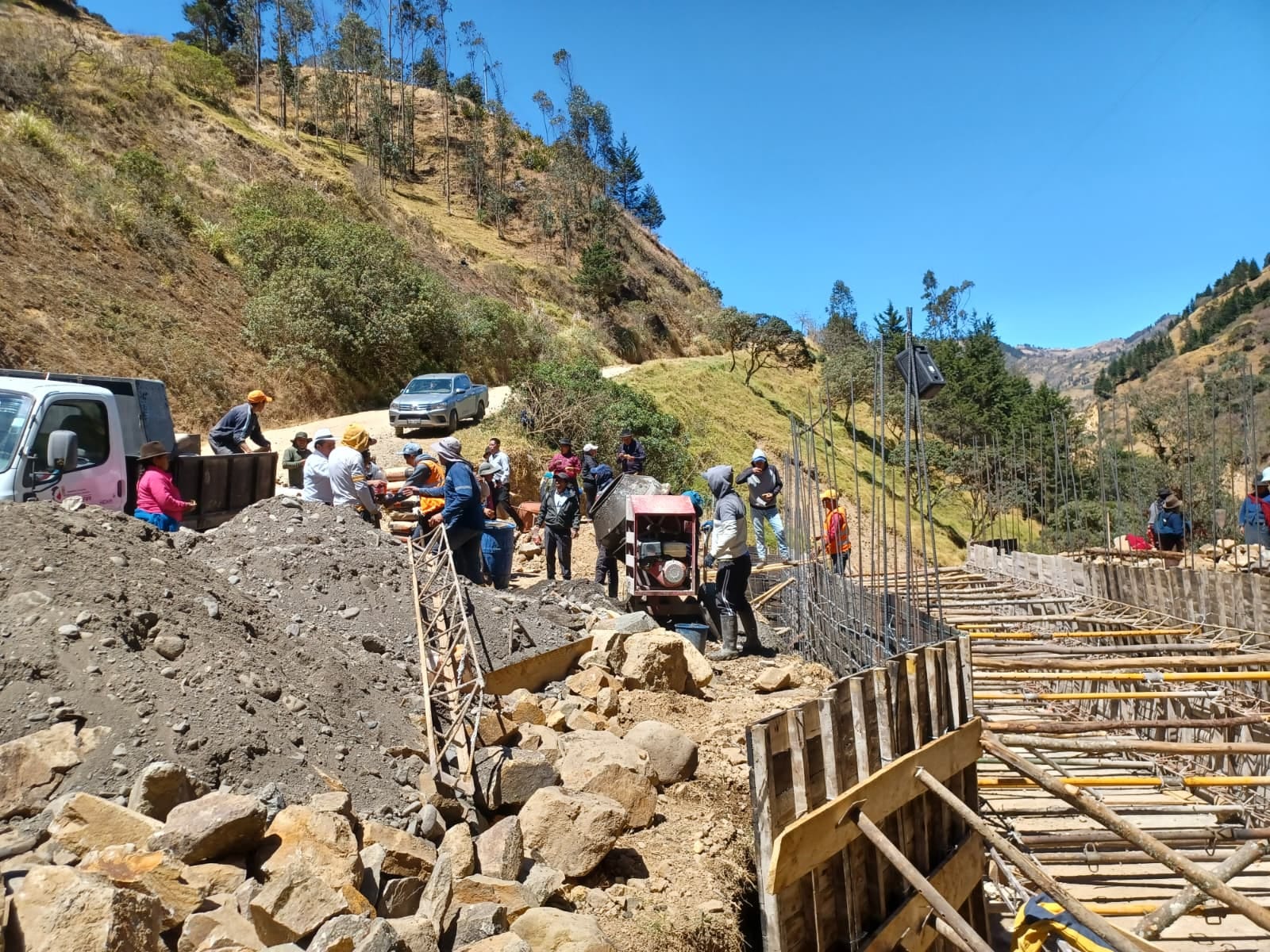
We reached the small community after about thirty minutes on the road and thanked our driver. Germán gave him some change, about a dollar in total for pasaje. Turns out that hitchhiking in Ecuador isn’t always a free ride. We grabbed our shovels and joined the small crowd gathered around the scene of the minga. The item in question was a large ditch, dug out to about ten feet deep with wood planks lining the walls. A series of wooden beams crossed the ditch and thin metal beams stretched high above its walls. It was in that moment that I finally out what the goal of the minga was. We would be building a bridge, and I was suddenly all the more thankful that I made sure to clarify I was not an engineer. Surrounding the bridge was a crowd of people from all walks of life, men and women of every age and from a vast array of different communities. This was a minga: a day of common work, when people from all walks of life come together to improve their community. Over time, people continued to trickle in to join the work, sometimes on foot, sometimes riding up in a pickup truck. The crowd grew and grew until there were somewhere around one hundred people gathered together to work. Someone brought an erquencho, a horn made out of a cow’s horn, and blew it every time a new group of workers arrived.
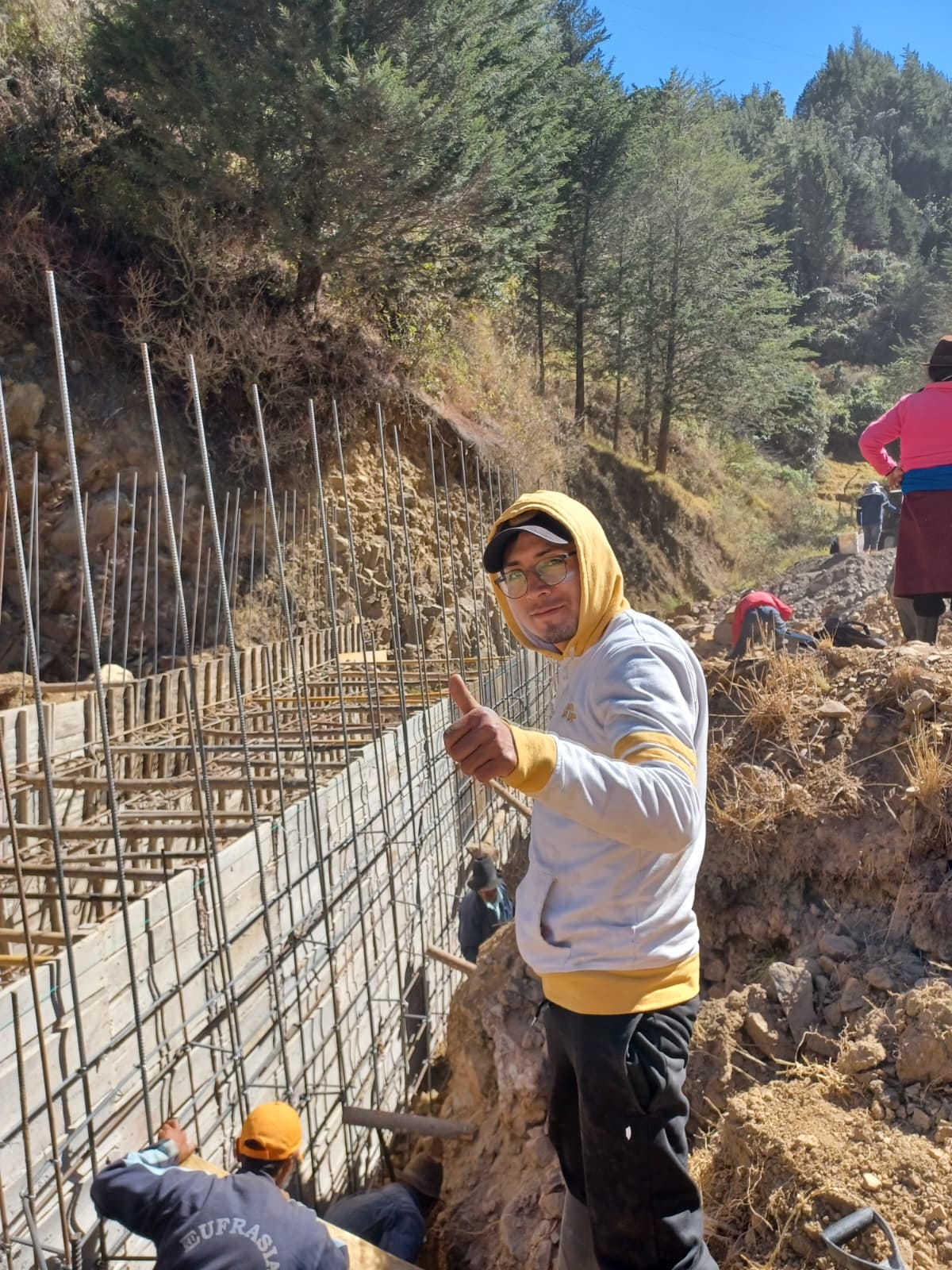
The beautiful thing about a minga is that everyone is welcome and everyone has a place: the real ingenieros were running the show and directing traffic, a group of men were running the machine to mix cement, the older men and women were helping clear space and shovel rocks and dirt. When the hose that was providing water for the concrete poved to be too slow and inconsistent, a group of people came together to pull water from the nearby stream and carry it, bucket by bucket, to the men mixing concrete. Germán and I found ourselves right in the middle of the action, shoveling dirt into the concrete mixer until it reached the right consistency. I quickly found myself covered in concrete specks and panting for air at the high altitude. An hour or so into the minga, a red pickup truck pulled up to drop off a small team of people, led by a man wearing a well-ironed shirt and a professional smile. He brought with him a large cardboard box full of bread and his assistants carried two-liter bottles of Coca-Cola. He was a político, trying to win votes by bringing a refugerio for the workers. Soon enough, the minga was flooded by políticos, passing out bread, soda, and sweets while we continued to work. One woman even put a colorful pulsera on my wrist as a reminder to vote for some particular article that I wasn’t familiar with. When I informed her that I couldn’t vote in this country, she told me to wear it nonetheless to encourage other people to vote. To my surprise, I even noticed one of the políticos joining in the work on the other side of the ditch.
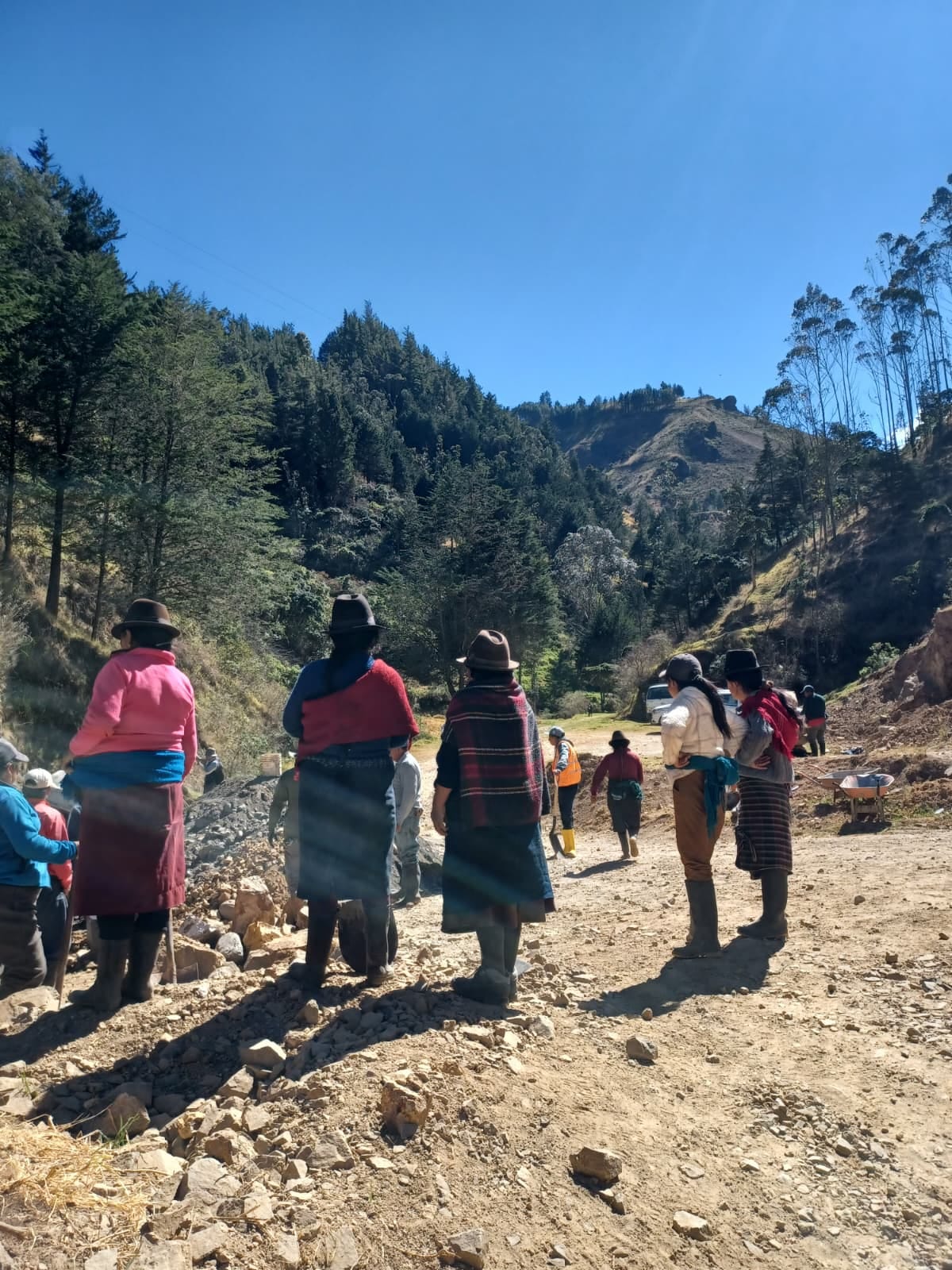
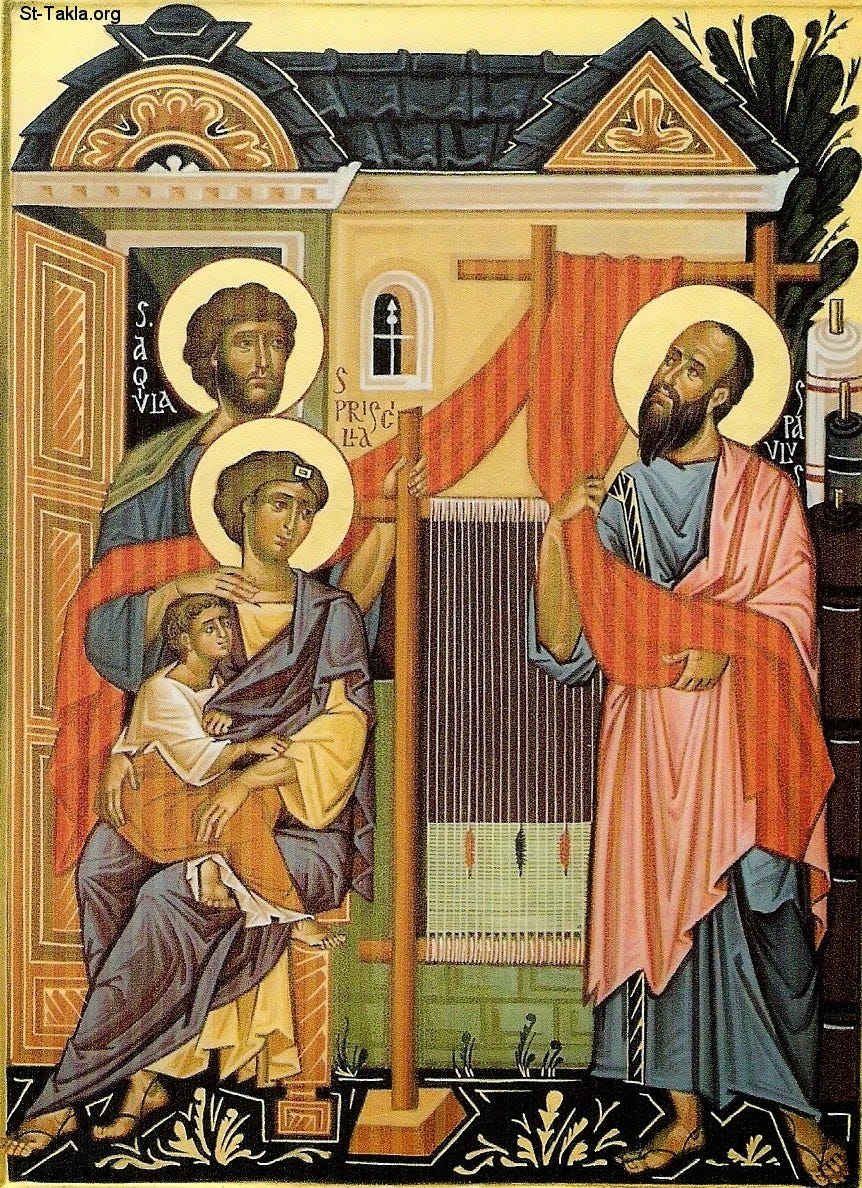
On paper, what Germán and I were doing wasn’t too dissimilar from what the políticos were doing: showing up not only to lend a hand and a shovel or two, but in a larger sense to represent the Church in Simiatug for the community. All in all, one or two extra shovels didn’t make that much difference in work, but that wasn’t entirely the point. The point was to be present, to accompany people in their daily lives and struggles, and to show them that the Church isn’t something far away and dissociated but something that draws in close — and it worked. I have a bad tendancy to stick out like a sore thumb as I am, most likely, the only gringo living in this entire canton. One woman even greeted me with a little buenas días, padrecito, which I resigned not to fight her on. While I was working, I couldn’t help but reflect on the first reading from Mass the day before, where St. Paul reminds the Corthians that he offers “the Gospel free of charge so as not to make full use of my right in the Gospel” (1 Cor 9:18). Paul, despite being employed in the full time job of a missionary to most of the Roman Empire, chose to take up a trade in order not to burden the people he served. In addition to preaching the Gospel and leading many Christian communities across the continent, he worked for several years as a tentmaker. As a missionary with a religious community, all of my needs are covered. I don’t pay rent for the bed that I sleep in, nor do I need to worry about buying food for my next meal. However, that priviledge comes with an obligation to participate in the life of the community, to serve the people of the parish not just spiritually but also to get dirty and assist with the reality of their day-to-day lives. Hence, the minga.
While working, I was also reminded of the famous quote from Teddy Roosevelt: “people don’t care how much you know until they know how much you care.” It’s one thing to listen to someone speak about the Gospel who you’ve never met and may never see again. It’s another thing entirely to listen to someone who has accompanied you into the dirt and the back-breaking labor, who has proved that they are invested in your lived reality. Someday, I’m confident that my mission will bring me back to Guangualiquin, and I’m hopeful that someone will recognize me as the gringo who came to the minga. Our work at the minga wasn’t just building a physical bridge — it was building a bridge of trust between the community and the Church. And not only did we represent the Church, but also Christ Himself. In the Mass, Catholics believe that the priest acts in persona Chrisi, as a living representative of Christ. Although I’m certainly not a priest, the woman who called me padrecito is proof enough that the people often view me as one, or at least as a source of spiritual authority. With that comes the important responsibility to portray Christ not as someone far away and inaccessible, but as He truly is: a loving Shepherd who draws in close to His sheep. In the Gospels, Christ is rarely far from the people. He doesn’t wait for the Samaritan woman to come to Him, He instead meets her at the well in the heat of the day (John 4). When His preaching and His miracles draw in so many people that the “large crowd… pressed upon Him” (Mark 5:24), He doesn’t flee from the masses but remains in their midst long enough that the woman with a hemorrhage can be healed. I wouldn’t be surprised to find Jesus right in mix of the minga, shovel in hand and brow covered in sweat.
You more attentive readers may have noticed a detail that I left out. Germán and I more-or-less hitchhiked down to Guangoliquin — which does in fact mean that we did not have a way to get back to Simiatug. We needed to get back to town around 1pm, meaning that we should be on the road around noon. The only problem: not a single car passed by the minga for the entire three-plus hour window we were there, with the exception of a single bus on its way from a coastal city to Ambato on the other side of the mountains. As the hour drew closer and closer to noon, it began to seem likely that we were either going to be asking kindly for another ride back or taking the journey on foot. Either option would get us back to Simiatug well later that we had hoped. However, the missionary life demands a deep trust in God’s ability to provide when situations get difficult. Germán didn’t seem particularly worried about our lack of a ride, nor did seem to even consider the option of walking back. And sure enough, at 11:55am on the dot, a bus appeared in the distance on the roadway on its way to Ambato. We boarded the bus mere minutes after the stroke of noon, right on time for our expected departure. When I asked Germán if he had known there would be a bus passing by, he merely smiled and shook his head. God had come through for His two little missionaries, but even if that bus hadn’t shown up, I pray that I might’ve had the grace to say, with St. Paul:
In every circumstance and in all things I have learned the secret… of living in abundance and of being in need. I have the strength for everything through him who empowers me. (Phil. 4:12-13).
Wishing you a joyful Sunday from the mission field,
Matthew